← to bookshelf
BOLES.ORG
dave boles
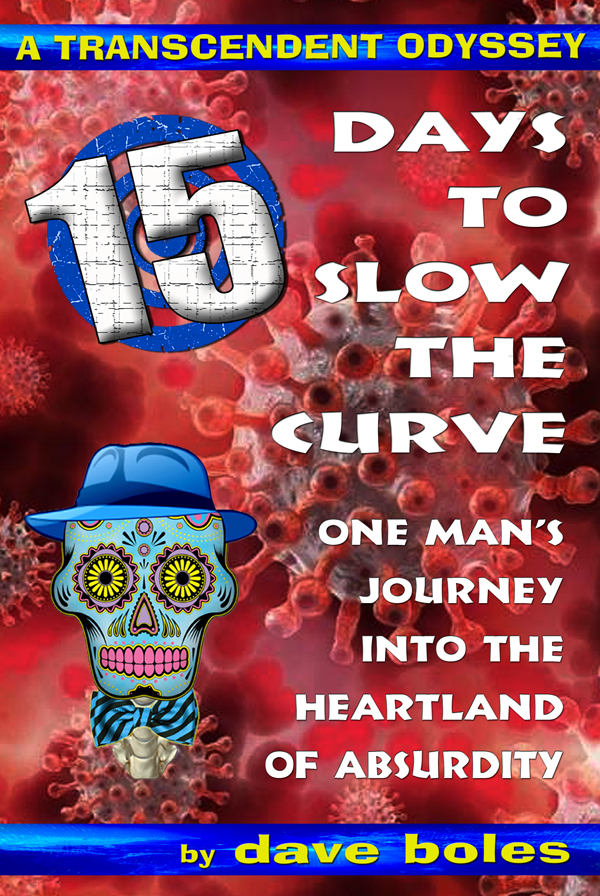
15 Days To Slow The Curve One Man's Journey Into The Heartland Of Absurdity
Large-Type Phone Edition • Free to Read
In the early moments of 2020, a terrible disease found its way to American soil. Within weeks it would savage the nation, leading to its borders being shutdown, emergency orders given for citizens to stay in their homes, and an ad-hoc committee of politicians, doctors, and scientists formed to lead Americans through the crisis of Sars-CoV-2, a coronavirus that would come to be known as COVID-19, or simply, the RONA.
In the early moments of 2020, a terrible disease found its way to American soil. Within weeks it would savage the nation, leading to its borders being shutdown, emergency orders given for citizens to stay in their homes, and an ad-hoc committee of politicians, doctors, and scientists formed to lead Americans through the crisis of Sars-CoV-2, a coronavirus that would come to be known as COVID-19, or simply, the RONA. What began as 15-Days to slow the curve in order to combat this new, nefarious disease, would ultimately lead into an ongoing miasma of tyrannical measures that continue to hold America hostage to this day. Dividing its citizens, supplanting their freedom with fear, media moguls and techno giants became demi-gods, decrying they alone would decide which information is allowed to be shared through their benevolent decrees. This is a story of those first few days when America still held on to its ideals of freedom.
Fear gripped America as Covid-19 continued its rampage. Schools were shutting down, film releases were postponed, campaign speeches were cancelled, health officials were creating media campaigns to teach us how to properly wash our hands—on top of all this Joe Biden cruised to the Democrat Party forefront in his bid to Make America Normal Again. Observing this once in a lifetime event of both national, and international, political and economic change, how could I not keep a journal as to the surreal madness that continued to unravel our world on a daily basis. I dutifully wrote daily an online "journal" through my Facebook news feed. Attempting to make sense of the nonsense we were confronted with, I listened to every briefing I could find and read countless articles from around the globe in journals that were as varied as the advice they gave. I listened to political, medical and cultural leaders as they all attempted to guide us through the fateful beginnings of COVID-19, to help us to find our way out of the vast morass we had been placed into. I wrote for family, friends, for myself. I wrote as much as I could in order to document this terrible disease and the pandemic that it brought to us. It was a great time to bear witness to the insanity that would become known to many as simply, RONA. Here, then, is the story as it unfolded.
- dave boles
Dispatches from the Screen-Lit Bunker:
A Review of 15 Days to Slow the Curve: One Man's Journey into the Heartland of Absurdity by dave boles (Cold River Press) In mid-March 2020, the federal government asked the American public for two weeks of cooperation to blunt the initial surge of COVID-19. That brief containment campaign, branded under the slogan 15 Days to Slow the Spread, swiftly mutated into months of rolling stay-at-home orders, shuttered main streets, and an unprecedented expansion of administrative authority. In 15 Days to Slow the Curve: One Man's Journey into the Heartland of Absurdity, dave boles presents a day-by-day chronicle of those tumultuous first two months (March 17 to May 17, 2020), tracking the national descent from cautious solidarity into ideological fracture and bureaucratic entrenchment. Written from the self-imposed isolation of his Grass Valley, California residence, boles’s journal offers a raw, idiosyncratic time capsule of a society undergoing sudden dislocation. The View from Lake House The book adopts an unvarnished diary format. Anchored at his “Lake House” alongside his wife, referred to affectionately as “Mrs. America,” boles establishes a morning ritual centered around black coffee, domestic survivalism, and the daily White House Coronavirus Task Force briefings. The narrative structure follows the calendar’s relentless progression, logging the daily political theater as the initial fifteen-day window is quietly extended to thirty, then sixty, and ultimately dissolved into open-ended state-level mandates. Boles brings a distinctive first-person voice to the material. Alternately folksy, furious, satirical, and contemplative, he writes with the sharp cynicism of a countercultural veteran and self-described “Gringo Shaman.” His prose is laced with colloquial jabs, irreverent nicknaming—President Trump is “Prez,” Dr. Anthony Fauci is “Dr. Tony,” and Dr. Deborah Birx is “Dr. Deb”—and dark humor born of sensory overload. When the daily parade of charts and models begins to strain credulity, boles breaks the tension with kitchen-table observations, ranging from the disappearance of store-bought bread to the therapeutic clarity of a glass of tequila or absinthe. Yet beneath the author’s sardonic wit lies a deep, simmering anger at what he diagnoses as a coordinated erosion of constitutional norms. Watching press briefings with obsessive attention, boles documents the increasingly adversarial sparring matches between the press corps and the podium. For boles, the mainstream media emerges not as an objective watchdog, but as an active participant in fear-mongering—a 24-hour industry invested in panic ratings, contradictory headlines, and moving goalposts. Anatomy of a Crisis As the days accumulate, 15 Days to Slow the Curve widens its aperture from press room theatrics to systemic critique. Boles focuses heavily on the economic fallout of the lockdowns, scrutinizing the mechanics of the CARES Act and the Small Business Administration’s Paycheck Protection Program (PPP). With biting clarity, he details how stimulus funds earmarked for vulnerable working-class operations were siphoned off by well-connected corporate entities and deep-pocketed institutions, while ordinary business owners were left stranded by Byzantine bureaucratic requirements. This economic commentary is woven into broader historical disquisitions. Boles takes detours through economic theory, tracing the arc from feudalism and mercantilism to modern debt-financed capitalism, arguing that the pandemic served as an accelerant for an economic reset that was already long overdue. His focus on escalating healthcare costs, public debt-to-GDP ratios, and corporate bailouts gives the diary an analytical weight that transcends simple partisan venting. Equally prominent is boles’s alarm over the expansion of the surveillance state. He catalogs the rapid deployment of police drones to monitor public parks, municipal snitch hotlines, and proposals for digital contact tracing and immunity certificates. Grounding his critique in local reality, he performs a detailed reading of California statutory law (including the Health and Safety Code), arguing that executive emergency decrees overstepped statutory and constitutional boundaries while bypassing legislative consent. By the time the journal reaches its final entries in mid-May 2020, boles characterizes the nation as an over-pressurized powder keg. In a retrospective Epilogue penned in August 2021, he connects these months of enforced isolation, economic ruin, and civic alienation directly to the social explosion that followed the killing of George Floyd on May 25, 2020—just eight days after the diary entries conclude. For boles, the nationwide civil unrest was not an isolated rupture, but the inevitable detonation of a society pushed to its psychological and economic brink. Strengths and Historical Immediacy The primary strength of 15 Days to Slow the Curve lies in its value as a primary source document. Because it was written in real time rather than polished by hindsight, it preserves the authentic fog of early 2020: the daily revisions of statistical models (such as the IHME projections), the whiplash of shifting public health guidance regarding masks and treatments, and the claustrophobic dread shared by millions of citizens tethered to their television screens. Boles succeeds brilliantly in capturing the surreal domestic dissonance of the period—the strange contrast between the tranquil natural beauty outside his window and the apocalyptic rhetoric broadcast from Washington and Sacramento. When he enlists esoteric metaphors—invoking Norse mythology, the memory of visionary figures like Gene Oldfield, or the allegorical wisdom of the "Church of the Illuminated Monkey"—he manages to elevate a political diary into a quirky, existential meditation on modern alienation. Limitations and Critical Caveats The book is not without notable structural and analytical limitations. The diary format, while authentic, inevitably breeds repetition. The reader is subjected to recurring recaps of press room shouting matches, cable news chyrons, and statistical rundowns that can feel numbing over prolonged stretches. The pacing is occasionally uneven, shifting abruptly from granular legal breakdowns to esoteric spiritual parables without clear transitional tissue. Moreover, boles’s perspective is unapologetically polemical and inherently constrained by his isolation. Because his window into the pandemic is largely mediated through television broadcasts, internet research, and short supply runs, his analysis occasionally suffers from the insularity of the screen-lit bunker. His skepticism toward epidemiologists, death-toll statistics, and viral origins frequently veers into sweeping assertions that invite contestation and would benefit from deeper, multidisciplinary verification. Readers looking for a detached, clinical assessment of public health trade-offs will not find it here; boles writes as an aggrieved citizen-witness, not a neutral arbiter. Conclusion 15 Days to Slow the Curve is a provocative, fiery, and deeply personal chronicle of an extraordinary historical moment. Dave Boles has produced a vital counter-narrative to the sanitized official histories of the early COVID-19 pandemic, giving voice to the deep skepticism, frustration, and sense of betrayal felt by citizens who saw their liberties curtailed under the banner of temporary crisis management. While its polemical edge and structural irregularities may challenge some readers, the book will be highly valued by historians of American political dissent, media analysts, and anyone seeking to understand the psychological and civic fractures that reshaped the nation in the spring of 2020. It stands as a vivid, uncompromising testament to the perils of trading liberty for emergency order.
© dave boles • Grass Valley, CA • boles.org