← to bookshelf
BOLES.ORG
dave boles
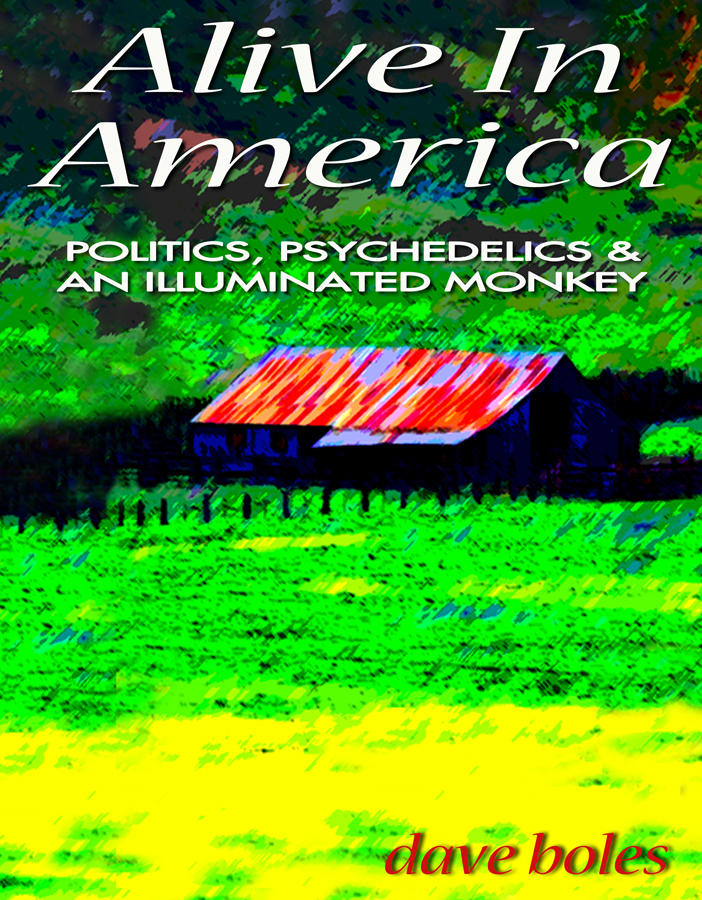
ALIVE IN AMERICA Politics, Psychedelics & An Illuminated Monkey
Large-Type Phone Edition • Free to Read
ALIVE IN AMERICA — prose fragments, poems, and typewriter art.
These are pages about being alive here — working, traveling, watching — America not as myth but as lived days. Some pieces are straight poetry, some are prose snapshots, some are visual typewriter drawings.
Like 4th Floor, Visions Of A Merciful Land, and Coyote Spirit, this one is fully interactive now — chapters linked, page headers back to TOC, footnotes linked both ways. Free to give away so the knowledge can go forward.
Alive In America: Politics, Psychedelics & An Illuminated Monkey is dave boles's sprawling, genre-defying meditation on American decline, spiritual possibility, and the persistence of consciousness amid systemic corruption. Spanning thirty-five years of observation, the collection weaves together poetry, prose, visual art, memoir, and mystical reflection to interrogate the machinery of political theater, media manipulation, consumer culture, and institutional hypocrisy. Boles moves fluidly between the personal and the political, the satirical and the sacred, documenting both the external collapse of American institutions and the internal landscapes of those who refuse to be fully programmed by the narratives sold to them. At the heart of the work stands the Illuminated Monkey—a mystical figure gifted by the ancient Anunnaki to teach humanity peace and love—serving as a counterpoint to the chaos of human violence, warfare, and political theater. Through this symbolic presence, boles suggests that enlightenment and redemption exist outside the systems that claim to offer them: not in churches performing charity for cameras, not in politicians promising change, not in the endless scroll of social media hatred, but in a consciousness that transcends the tribal divisions and manufactured conflicts that define contemporary American life. The narrator's voice throughout is sardonic, unflinching, and deeply skeptical—observing with dark humor the contradictions between what America claims to be and what it actually does, from the hypocrisy of honoring soldiers while destroying them to the absurdity of pandemic logic to the casual brutality embedded in everyday commerce. Boles explores mortality, memory, and the possibility of honor in a dishonored age. He moves between scenes of urban decay and rural refuge, between psychedelic dissolution and practical wisdom, between the battlefield where politics dissolve into naked survival and the mystical realms where truth and peace reside. The collection asks what freedom means when surveillance is total, what civilization means when violence is systemic, and what love means when institutions have corrupted every language in which it might be spoken. Alive In America is ultimately a work about remaining conscious, remaining human, and remaining alive—not merely in the biological sense, but in the capacity to see clearly, to resist programming, and to seek solace in the teachings of those who have learned to live deliberately outside the machinery of control.
Book Review A Feral Bible for the Disillusioned Alive In America refuses to sit still. It is a poem, then a rant, then a confession, then a sketch, then a myth—sometimes all four within the space of a single page. dave boles has spent thirty-five years accumulating fragments of American life, and rather than smoothing them into a single coherent narrative, he has chosen to leave the edges jagged. The result is a hybrid text that resists categorization: part satirical broadside, part psychedelic travelogue, part memoir of a body that has been drunk, high, wounded, and awake in equal measure. Readers looking for a tidy arc will not find one here. What they will find instead is a voice—relentless, sardonic, occasionally tender—cataloguing the failures of American institutions while insisting, against all evidence, that something like grace remains possible. The book's opening gesture sets the tone precisely. "A Dissolution Of Honor" invites the reader to "dance around fires / fueled by enemy bones" and "eat bread baked from stolen innocence"—an incantation that turns collective self-destruction into ritual, even liturgy. It is a deliberately uncomfortable overture, and boles seems to want it that way. He is not interested in easing anyone into his worldview. The title poem, "Alive In America," arrives later as a kind of thesis statement, cataloguing police brutality, children treating violence as spectacle, bankers and politicians fusing into a single corrupt organism—and yet closing not in despair but in the flat, stubborn assertion that "we are alive / in America." That refusal to resolve into either nihilism or patriotism is the book's most consistent move: it holds contradiction rather than solving it. Boles is at his sharpest when he lets absurdity do the political work. "9/12/2012" and "Pretzel Logic" read like found poetry pulled directly from news cycles, their power derived from simple juxtaposition rather than commentary—the incoherence of the headlines is the argument. Elsewhere the satire curdles into something darker and funnier: "Adopting Politicians," with its image of caged legislators available for adoption "like so many feral cats," or "The Illuminated Monkey" purchasing sundresses for migrants at the Texas border, weaponizes a kind of deadpan surrealism that recalls both Vonnegut's gallows humor and outsider-art irreverence. But the collection's emotional weight lives elsewhere—in the pieces where boles drops the megaphone and picks up a shovel. "Killing The Dog" is the book's quiet triumph: a rural mentor who refuses to speak to a friend over politics for months, yet shows up without hesitation to help end a suffering animal's life. It is the closest the book comes to offering an ethics, and it lands harder for being unadorned. "Memorial Day, 2011" performs similar work through elegy rather than instruction—the neighborhood's beloved, damaged veteran, mythologized by children and abandoned by the institutions that made him, ends the poem dead by his own gun and medals. Boles doesn't editorialize the death; he simply lets the accumulated affection of the town collide with the fact of the suicide, and the hypocrisy announces itself. "Made In America" is the book's most sustained memoir passage, tracing a childhood of manicured-lawn television myths against the lived reality of segregated schools and returning war dead, and it's here that boles's personal history and his political fury visibly fuse—this isn't abstract critique, it's autobiography weaponized. And then there is the Illuminated Monkey itself, whose full cosmology arrives late in "From The Codex Of The Illuminated Monkey." The Anunnaki myth—slave-engineered humanity, abandoned to a war consciousness, redeemed by one enlightened creature left behind to teach peace—functions as the book's spiritual counterweight to everything preceding it. It's a strange, almost childlike mythology dropped into a collection otherwise obsessed with news cycles and bar fights, and that strangeness is the point: illumination in this book doesn't arrive through institutions, scripture, or politics, but through something feral, animal, and outside the systems that claim moral authority. The Monkey is less a character than a permission slip—proof that peace can be imagined even by a mind marinated in freon, amyls, and cynicism. None of this is easy reading, nor is it meant to be. The book's tonal volatility—swinging from tenderness to vulgarity to myth to headline collage within a few pages—can feel disorienting, and some readers will find the repetition of certain moves (the drug-fueled hallucination, the news-ticker juxtaposition, the "we are not civilized" refrain) wearing by the collection's back half. The provocations are frequent and sometimes gratuitous; boles clearly intends to offend the comfortable, and he occasionally offends indiscriminately rather than precisely. Pieces like "Two Consonants Surrounded By E's" are less poems than gestures, testing the reader's patience as much as making a point. Yet the abrasiveness is also the book's engine—sand it down and you'd lose the friction that makes the sincere moments, like "Killing The Dog" or "Shambhala," hit as hard as they do. Alive In America is not a book for readers seeking comfort, closure, or ideological validation from either direction of the political spectrum—boles is equally contemptuous of left and right, church and state, patriot and protester. It is, instead, a book for readers who want their disillusionment given shape and, occasionally, given wings: fans of Bukowski's barroom clarity, Ginsberg's incantatory rage, or Hunter S. Thompson's chemical journalism will recognize the lineage immediately. It is uneven by design, exhausting by intention, and, in its best passages, genuinely illuminating—a monkey's-eye view of a civilization that insists it's civilized while proving, page after page, that it is anything but.
Are you alive in America? You think so? How can you tell? Now there is a way to tell. dave boles has outlined a common vision for all of us. If you can listen, this is the story of what it is really like to be alive in America. This is a carefully crafted and extremely well-written look at how we are today and how we got here. This book is a bright light on dark corners. A clear voice reaching out to each of us. A testament to a belief in kindness and a studied understanding of who and how we have become what we are. This is a serious book, peppered with good humor and an open heart to help explain the unexplainable, i.e. what it is really like to be Alive in America. Read this book.
D.R. Wagner
a 35 year selected collection of "okie surrealist" poems, including 5 typewriter poems and signature illuminated monkey iconography by alter ego bodhi presents a spectrum of twists and turns bound to confound many minds into altered realms. two typewriter poems as bookends set the tone from gallows humor to the demand to remain independent from group thought. his poem "Civilized" opens with "the great lie / we all live with / is that we are civilized" followed by his typewriter poem "A Classic Representation Of The Eternal Struggle Between Good And Evil" when writing "Waiting For The Resurrection of Civility," he, like kenneth patchen, takes no prisoners. this is not for the faint hearted or politically correct. poignant moments are found in "The Art Of Rolling A One Paper Joint," "Memorial Day, 2011," and "Halcyon Days" for the disenfranchised. and, among the timeless poems are "Covenant," "It's A Messy Business," "Shambhala," and "The Codex Of The Illuminated Monkey," in which we read "They gave one monkey / the gift of illumination, / the power to see beyond/ the petty machinations / of man. such is, the intention of this devotee of the illuminated monkey accompanied by his side kick the gringo shaman hidden behind and in between the lines.
karl kempton
© dave boles • Grass Valley, CA • boles.org