← to bookshelf
BOLES.ORG
dave boles
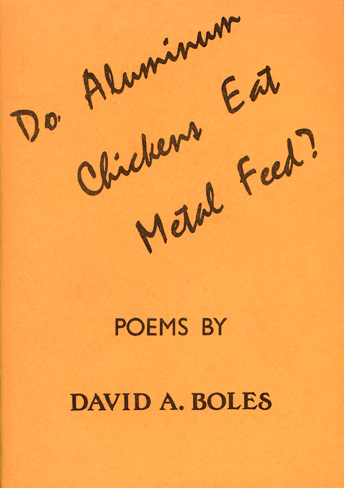
DO ALUMINUM CHICKENS EAT METAL FEED
Large-Type Phone Edition • Free to Read
My First Chapbook (1986)
40 pages + soft cover, 5 x 6, Saddle Stitched
Originally Published By Neural Impulse Publictions
40 pages + soft cover, 5 x 6, Saddle Stitched
Originally Published By Neural Impulse Publictions
An epic alternative publishing experience in the Valley Of Print
I published this chapbook at Ben Hiatt's place in Mt. Aukum. Ben had been my mentor for years, teaching me alternative publishing, and we decided it was time I collected together my first chapbook.
Living in Reno, NV at the time, I packed my faithful car, my Blue Guru, and headed to what I had come to know as the Valley Of Print.
I typed out the book on paper masters using an old Royal stand up typewriter. We then made paper plates by exposing them to the sun for the duration of two beers and one joint.
The cover stock and interior pages were from leftover paper from various print projects that had collected a fine layer of dust that had to be swept clean before they could be run through the press, and old AD Dick 360.
We ran a quantity of around 500, more or less (more beers and a few joints later we had lost count). The individual pages were folded on an old antique table top folder I swore was from the Civil War. The only modern piece of equipment used was a cutter I had given Ben as a present, and that dated to the early 60s.
By the time the book was completed it had taken all day and into the night to complete. We had consumed a case of beer (Pabst Blue Ribbon), many joints, a fair amount of coke, and all of Julienne's pickled peppers (Ben's wife). So many empty Ball Jars!
By my standards today, it was definitely crude, but I loved it! The title came from my friend, Ken Hill, who ran Aluminum Chicken Press. He had printed issues 2 and 3 of my magazine, Primal Urge. One night, late, as we were printing in the wee hours of the morning, I looked over at Ken and asked "Do Aluminum Chickens Eat Metal Feed?" Ben loved that story and when it came time to name my first chapbook how could we not call it Do Aluminum Chickens Eat Metal Feed".
Fun times!
A Review of Do Aluminum Chickens Eat Metal Feed?
There is a particular kind of daring that belongs only to a first book, and David A. Boles's 1986 chapbook wears that daring like a stained work shirt: proudly, unapologetically, without much interest in whether it fits. Do Aluminum Chickens Eat Metal Feed? is not a polished object. It is a document of a young poet thinking out loud, arguing with George Orwell, apologizing to a lover from inside a stalled car, and trying to figure out what a person owes the world when the world is busy massacring itself in Beirut. That it manages to be genuinely moving in spite of — or because of — its rough edges is the chapbook's real achievement.
Boles's voice announces itself immediately in its refusal of capital letters and its allergy to tidy grammar. The lowercase "i" that wanders through these poems isn't a typo; it's a political posture, a small daily refusal of hierarchy that runs underneath even the gentlest lines. It is beat-inflected without being derivative — you can hear Ginsberg's cadences and Bukowski's flat, unimpressed diction, but Boles's fractured lineation and sudden line-breaks ("Shit." landing alone like a dropped plate) feel like his own nervous system, not borrowed style. The poems don't build toward epiphany so much as stumble into it and then shrug.
The title poem sets the collection's governing joke and its governing anxiety in one breath. The aluminum chicken — dumb, mass-produced, industrial — becomes a stand-in for every unanswerable question the poet can't stop asking. The forward's claim to have found real answers "in a bar in the Green Light District of Pusan, Korea" and then discarded them for the simpler truth that aluminum chickens "can dance" is Boles at his most beautifully absurd: existentialism reduced to a barnyard toy, philosophy defeated by its own punchline. It's a young man's move, but it's an effective one, and it tells you everything about how seriously — and unseriously — he intends to take the sixty-some pages that follow.
That register of comic deflation runs alongside a much colder strain of social anger. "After Reading of Massacre in Beirut, Lebanon" catches the poet mid-embarrassment, watching cafe intellectuals trade Nietzsche and Goethe while actual bodies pile up overseas — "we must liberate / the spirit of man" reads almost sarcastically against the poem's undertone of guilt. Harvey, the imp perched on the speaker's shoulder pissing on friends' draperies, is chaos personified and preferred, deliberately, to the responsibilities of a normal life; he's funny until you notice how much dread is hiding behind the joke. The Big Bad Wolf poem performs the same maneuver in miniature — everybody writes about wolves eating girls in fairy-tale woods, "such a pity, such a pity," while nobody writes about the actual abandoned children in actual city sewers. Boles keeps returning to this same accusation: that art prefers its tragedies decorative and distant.
The Marcel Duchamp tribute and the Madelyn poem show a gentler, more playful side — Duchamp's "three views" repeated and mangled is Boles trying his hand at pure conceptual mischief, language dismantled for the pleasure of watching it fall apart; Madelyn, dancing under cafe neon toward something like satori, is the collection's closest approach to unguarded tenderness. Both poems feel like breathing room before the book's real gut-punch arrives.
Because the "1984" sequence is where this chapbook stops being clever and becomes something else entirely. Boles picks a fight with Orwell — "did you or I believe love to be a fascist?" — and then spends three dated movements getting his answer beaten out of him by his own body. Lungs filling with fluid. A brother killed in May by "a piece of metal," buried under a sky the poet insists on filling with his own god's words instead of Orwell's, or anyone else's borrowed comfort. Legs gone by August, months spent crawling "like an infant," the terrible admission that 1984 was never prophecy — it was just late, and now it had arrived on schedule inside his own paralyzed limbs. By December, walking again, he calls Orwell "Mere / Mere / Man, / with a vision" — deflating the myth of the visionary writer down to human size, the same way the title poem deflated grand philosophy down to a toy chicken. It's the collection's most sustained, most autobiographical writing, and its typographical stutters — the repeated words, the sentence fragments, the line breaks that seem to buckle under weight — read here not as amateurish tics but as the actual shape of grief on the page.
None of this would exist in quite the form it does without knowing how the book was made. Boles has said this was his first chapbook: paper-master plates exposed by laying them out in the sun, then run through an old AD Dick 360 by his mentor Ben Hiatt. That's worth sitting with. This is not a manuscript that passed through editors and typesetters and a press's house style — it's a book assembled by hand, exposed to actual weather, cranked out on a duplicator machine that had probably already outlived its warranty twice over. The chapbook's rawness — the uneven margins of feeling, the poems that don't quite land, the ones that land too hard — is inseparable from that production history. This is DIY literary culture in its most literal sense: sunlight as darkroom, an old machine and an older friend as the entire publishing apparatus. The book's aesthetic of improvised resistance isn't a pose borrowed from the Beats; it's the actual physical condition under which it was printed.
Read forty years on, Do Aluminum Chickens Eat Metal Feed? is uneven in the way that early work is supposed to be uneven — some poems arrive nowhere, some arrive exactly where they need to. But the best of it, especially the "1984" sequence, still hits with real force, and the whole thing carries the unmistakable charge of a writer discovering, in real time, that a chapbook could hold both a bad joke about a metal chicken and the death of his brother, and that neither one would cancel the other out. Whatever else it is, it is unmistakably alive — sun-exposed, hand-run, and still stubbornly asking its ridiculous, necessary question.
© dave boles • Grass Valley, CA • boles.org