Large Type = auto-big on phone, saves place, A-/A+ resize. pdf = print version, zoomed.
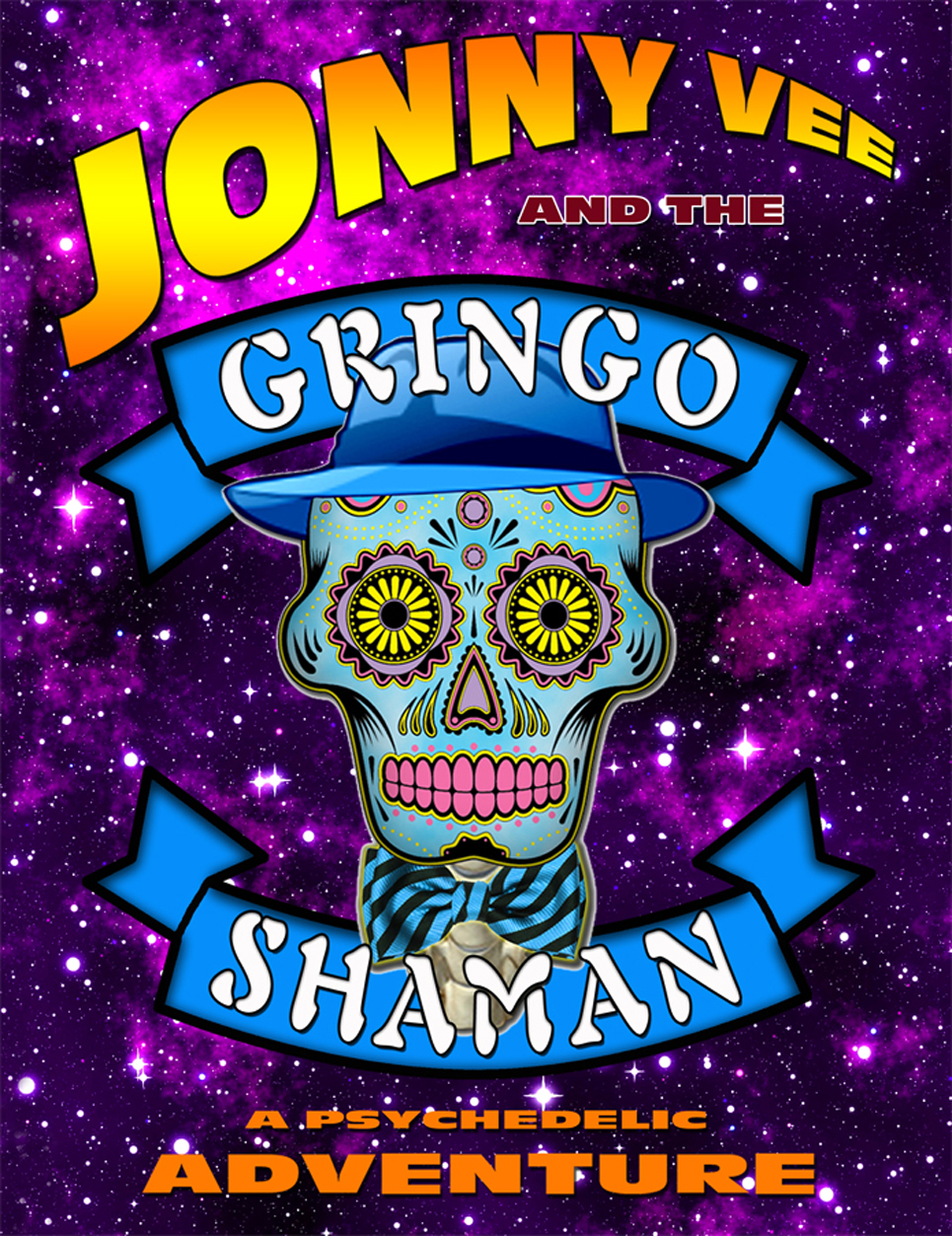
Jonny Vee & The Gringo Shaman is not about drugs. It's about who was giving them, who was watching, and what they wrote down.
About this book:
A noir psychedelic detective thriller following Jonny Vee, a hard-boiled private detective, as he's drawn into a dangerous case involving a criminal organization called The Collective, three mysterious siblings (Amanda, Amy, and Alex), and a conspiracy that reaches far beyond the Valley. The narrative alternates between Vee's increasingly hallucinogenic perspective and the Lieutenant's investigation, with layers of deception, violence, and unreliable perception at its core. The ultimate revelation: The triplets are not human but creations from a 1952 Roswell-related science experiment, timeless and unaware of their true nature. The machine elves, the Gringo Shaman (revealed to be the Monad—the fundamental unity of consciousness that dreams universes into being), and the interdimensional technology discovered at Roswell are all real—and control of them is what the conspiracy truly revolves around. Vee witnesses the triplets' awakening and transcendence, the collapse of The Collective, and chooses to become the guardian of this cosmic secret, remaining in the Valley to watch over the boundaries between dimensions. He survives with his humanity intact, the burro as his eternal companion, and the knowledge that he'll witness the day humanity becomes ready to step beyond their single dimension.
A Review of Jonny Vee And The Gringo Shaman
★★★★★
Jonny Vee And The Gringo Shaman doesn't just describe psychedelia, it induces it. You don't read this book so much as consume it—the prose becomes a hallucinogenic substance itself. By the time Jonny Vee swallows those first mescaline pills, you're tripping with him. When he combines mescaline with DMT in a ventilation shaft, your perception fractures identically. The narrative doesn't explain altered consciousness; it demonstrates it through destabilized prose, collapsing reality, and voices that shouldn't exist. The genius is in the architecture of unreliability. Early chapters are noir-standard; hard-boiled detective, straightforward case, and familiar cynicism. Then the drugs arrive. The Lieutenant's face becomes "too symmetrical," like a Las Muertas death skull. Sweat becomes a torrential flood. Words fall into canyons. The prose syntax itself begins to break—sentences fragment, perspectives splinter, time dilates and compresses. And through it all, the burro talks. Sometimes wisdom. Sometimes absurdism. Sometimes just companionship from a part of Vee's consciousness that can see beyond consensus reality. He's not a gimmick; he's a guide through the fracturing of self. The psychedelic sequences are where this book transcends genre. When Vee escapes through ventilation ducts hallucinating in real-time, when the Gringo Shaman materializes and reality warps around him like wet glass, when the machine elves manifest as "fractal geometries constantly shifting—insectoid, crystalline, living mathematics"—these aren't descriptions of a trip. They're the trip itself, translated into language. The author captures something true about high-dose psychedelics; the simultaneous exaltation of terror and beauty, the dissolution of self, the revelation that consciousness isn't fixed but negotiable. Vee doesn't just use drugs to survive the case—the drugs force him to perceive what was always true—that reality itself is consensus, that dimensions bleed into each other, and that entities exist on frequencies most people never access. What's stunning is that beneath the cosmic surrealism, the emotional core remains anchored. The triplets' discovery of their own inhuman nature carries genuine grief. Duarte's suicidal ideation before the case gives him weight. The Monad's apology for 70 years of manipulation lands because we understand what was stolen; seventy years of authentic human experience. The climax doesn't resolve into conventional victory. Instead, it expands; the Monad reveals it has been pruning civilizations, reshaping continents, and birthing conscious universes through Earth's "Barbello"—the divine feminine principle. Vee becomes a guardian of cosmic secrets. The Collective is erased from existence itself through machine elves rewriting reality at the quantum level. It's cosmic horror filtered through enlightenment philosophy, psychedelic revelation, and noir pragmatism. By the final pages—where Vee wears a blue fedora (the mark of crossing between dimensions) and acknowledges that "the old world was gone"—you realize the book has remade you slightly. You've been altered by proximity to Vee's altered consciousness. Jonny Vee And The Gringo Shaman is what happens when a writer takes psychedelic philosophy seriously and renders it with literary rigor. It's a detective novel that becomes a mystical text, a thriller that becomes a ceremony of consciousness expansion, a noir that becomes a map of how the universe dreams itself into being. Don't read this if you want comfortable escapism. Read it if you want to be genuinely disoriented, transformed, and left wondering which dimension you actually inhabit when you close the book. — From A Reader Still Seeing Fractals