← to bookshelf
BOLES.ORG
dave boles
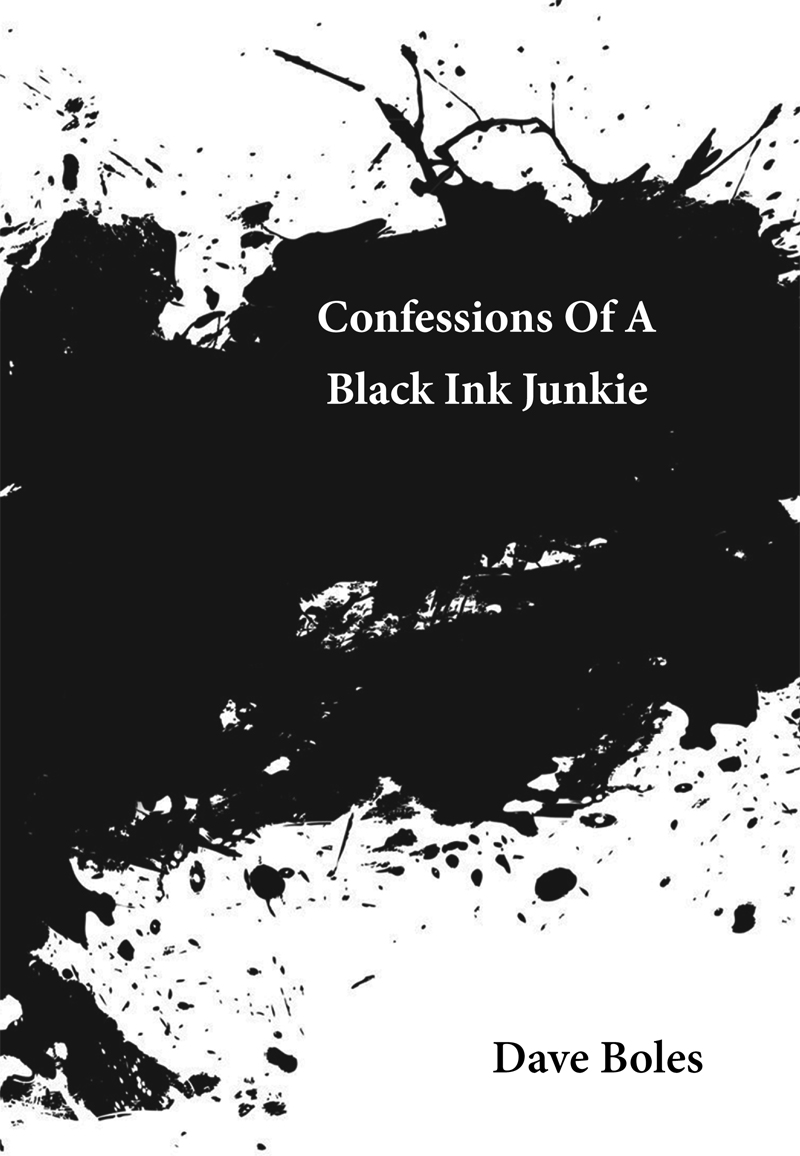
CONFESSIONS OF A BLACK INK JUNKIE
Large-Type Phone Edition • Free to Read
48 page chapbook + cover, 1 long poem, 5x7 Saddle Stitched
With Foreword by Charles Plymell
With Foreword by Charles Plymell
REVIEW: Ink in the Blood - David A. Boles Turns Print Addiction into a Manifesto
There is a particular kind of writer who cannot separate the tools of the trade from the soul that wields them, and David A. Boles is unmistakably one of them. Confessions of a Black Ink Junkie is less a poetry collection than an extended, feverish testimony—an addict's confession in which the drug of choice is not a chemical compound but the black ink and raised type of the printed page. It is a strange, blunt, often exhilarating book, and one that arrives at a moment when its central anxiety—about screens replacing the tactile, considered, ink-stained world of print—feels less like nostalgia than warning.
The book unfolds in three parts, each marking a stage in the narrator's relationship with his obsession. Part I is pure euphoria: a breathless, almost liturgical account of the print shop as sacred space, where chemical fumes and the churn of the press become a kind of communion. Boles leans hard into religious vocabulary—Gutenberg as "lord and saviour," the press as a god demanding worship, ink staining not just paper but "mind and soul." It's audacious, even a little absurd, but the audacity is the point. The narrator isn't being ironic when he calls a printing press holy; he means it, and the poem's commitment to that sincerity is what makes the opening section work.
Part II complicates the ecstasy. The narrator, no longer satisfied with the "initial fix" of black-and-white text, discovers color printing—the four-color process of yellow, magenta, cyan, and black—and mistakes it for paradise. He believes he has found a promised land of milk and honey, a new Jerusalem of full-color reproduction. But the high is thin. Boles pivots hard here, and the language sharpens into something closer to disgust: color doesn't matter, message doesn't matter, only "the feel of ink and the selfish glow." This is the book's most interesting turn—not simply a lament for print over digital media, but a recognition that print itself can be corrupted the moment it serves spectacle over substance. The addiction metaphor does real work in this section: the narrator isn't just criticizing color advertising from a safe distance, he's confessing to his own complicity in it.
By Part III, the narrator has collapsed—"groveling," "naked and worthless" on his own altar—only to rise again with something like clarity. The demons of advertising, marketing, and the ever-lit "view screen" have taken the masses captive, but the narrator's addiction, it turns out, is the one thing the demons overlooked. His final campaign is a call to reclaim independent thought from what he calls corporate machines that dictate the image and demand attention. The book's closing lines—"I am a black ink junkie, baby"—land with the theatrical bluntness of a man who has nothing left to lose and one last message to print, in his words, "in blood and ink."
Charles Plymell's foreword sets the table well for what follows. Plymell, writing from decades of intimacy with the mechanics and culture of print, reflects on printers having ink in their blood almost literally—the trade as inheritance, as bodily fact rather than metaphor. His attention to the history and physical mechanics of the press, and to the particular excitement of the first impression pulled from a freshly inked plate, gives the collection a grounding it might otherwise lack. Where Boles's poem operates at the pitch of confession and complaint, Plymell's prose supplies context and craft-knowledge, reminding readers that this obsession with ink has a long, unglamorous, and genuinely fascinating lineage.
It would be dishonest not to flag the poem's excesses. Boles repeats himself relentlessly—ink, fix, message, demons, machine—and the rhetoric can tip into polemic that occasionally forgets subtlety. The profanity and blunt address ("baby," used as both endearment and provocation) will not be for every reader, and some stretches feel more like manifesto than poem. But this is, importantly, a feature rather than a flaw of the persona Boles has built. Junkies are repetitive. They circle the same craving, the same self-justifications, the same collapses and resurrections. The poem's excess mimics the compulsive structure of addiction itself, and read that way, the relentlessness becomes purposeful rather than sloppy.
What ultimately elevates Confessions of a Black Ink Junkie above a simple screed against digital culture is its refusal to let print off the hook. This is not a book arguing that paper is virtuous and screens are evil; it's a book arguing that any medium—ink or pixel—can be weaponized into spectacle, and that the only real antidote is a return to purity of message over purity of format. In an age of algorithmic feeds and infinite scroll, that argument lands with more urgency than comfort.
This is a raw, unruly, deeply sincere book. It won't convert skeptics of confessional free verse, and its hammering repetitions demand patience. But for readers willing to meet its intensity, Confessions of a Black Ink Junkie offers something increasingly rare: a writer willing to bleed—literally, by his own closing image—for the printed word. Recommended, with the caveat that you should be ready to feel lectured to, occasionally profanely, by a man who genuinely believes ink might still save us.
There is a particular kind of writer who cannot separate the tools of the trade from the soul that wields them, and David A. Boles is unmistakably one of them. Confessions of a Black Ink Junkie is less a poetry collection than an extended, feverish testimony—an addict's confession in which the drug of choice is not a chemical compound but the black ink and raised type of the printed page. It is a strange, blunt, often exhilarating book, and one that arrives at a moment when its central anxiety—about screens replacing the tactile, considered, ink-stained world of print—feels less like nostalgia than warning.
The book unfolds in three parts, each marking a stage in the narrator's relationship with his obsession. Part I is pure euphoria: a breathless, almost liturgical account of the print shop as sacred space, where chemical fumes and the churn of the press become a kind of communion. Boles leans hard into religious vocabulary—Gutenberg as "lord and saviour," the press as a god demanding worship, ink staining not just paper but "mind and soul." It's audacious, even a little absurd, but the audacity is the point. The narrator isn't being ironic when he calls a printing press holy; he means it, and the poem's commitment to that sincerity is what makes the opening section work.
Part II complicates the ecstasy. The narrator, no longer satisfied with the "initial fix" of black-and-white text, discovers color printing—the four-color process of yellow, magenta, cyan, and black—and mistakes it for paradise. He believes he has found a promised land of milk and honey, a new Jerusalem of full-color reproduction. But the high is thin. Boles pivots hard here, and the language sharpens into something closer to disgust: color doesn't matter, message doesn't matter, only "the feel of ink and the selfish glow." This is the book's most interesting turn—not simply a lament for print over digital media, but a recognition that print itself can be corrupted the moment it serves spectacle over substance. The addiction metaphor does real work in this section: the narrator isn't just criticizing color advertising from a safe distance, he's confessing to his own complicity in it.
By Part III, the narrator has collapsed—"groveling," "naked and worthless" on his own altar—only to rise again with something like clarity. The demons of advertising, marketing, and the ever-lit "view screen" have taken the masses captive, but the narrator's addiction, it turns out, is the one thing the demons overlooked. His final campaign is a call to reclaim independent thought from what he calls corporate machines that dictate the image and demand attention. The book's closing lines—"I am a black ink junkie, baby"—land with the theatrical bluntness of a man who has nothing left to lose and one last message to print, in his words, "in blood and ink."
Charles Plymell's foreword sets the table well for what follows. Plymell, writing from decades of intimacy with the mechanics and culture of print, reflects on printers having ink in their blood almost literally—the trade as inheritance, as bodily fact rather than metaphor. His attention to the history and physical mechanics of the press, and to the particular excitement of the first impression pulled from a freshly inked plate, gives the collection a grounding it might otherwise lack. Where Boles's poem operates at the pitch of confession and complaint, Plymell's prose supplies context and craft-knowledge, reminding readers that this obsession with ink has a long, unglamorous, and genuinely fascinating lineage.
It would be dishonest not to flag the poem's excesses. Boles repeats himself relentlessly—ink, fix, message, demons, machine—and the rhetoric can tip into polemic that occasionally forgets subtlety. The profanity and blunt address ("baby," used as both endearment and provocation) will not be for every reader, and some stretches feel more like manifesto than poem. But this is, importantly, a feature rather than a flaw of the persona Boles has built. Junkies are repetitive. They circle the same craving, the same self-justifications, the same collapses and resurrections. The poem's excess mimics the compulsive structure of addiction itself, and read that way, the relentlessness becomes purposeful rather than sloppy.
What ultimately elevates Confessions of a Black Ink Junkie above a simple screed against digital culture is its refusal to let print off the hook. This is not a book arguing that paper is virtuous and screens are evil; it's a book arguing that any medium—ink or pixel—can be weaponized into spectacle, and that the only real antidote is a return to purity of message over purity of format. In an age of algorithmic feeds and infinite scroll, that argument lands with more urgency than comfort.
This is a raw, unruly, deeply sincere book. It won't convert skeptics of confessional free verse, and its hammering repetitions demand patience. But for readers willing to meet its intensity, Confessions of a Black Ink Junkie offers something increasingly rare: a writer willing to bleed—literally, by his own closing image—for the printed word. Recommended, with the caveat that you should be ready to feel lectured to, occasionally profanely, by a man who genuinely believes ink might still save us.
© dave boles • Grass Valley, CA • boles.org