← to bookshelf
BOLES.ORG
dave boles
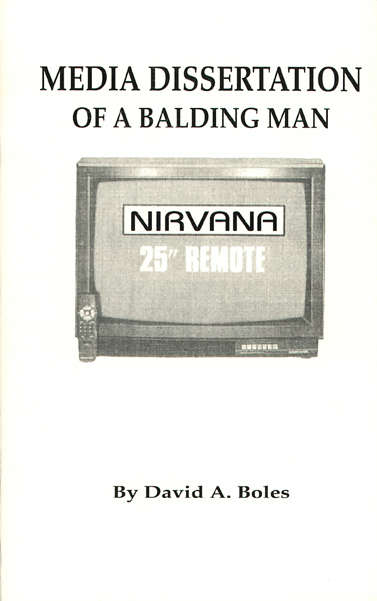
MEDIA DISSERTATIONOf A Balding Man
Large-Type Phone Edition • Free to Read
Two books In One! Includes Homage To A Word
52 pages + soft cover, 5.5 x 8.5, Perfect Bound
Click Here For Homage To A Word
I wrote this piece in November, 1991, as a one time performance piece for my friend, Larry Killen, who had invited me to read at an art gallery's opening (Lite Rail Gallery in Sacramento, CA).
Larry insisted on a new piece for the reading, which I viewed as idiosyncratic, but what the hell. To make it all the more interesting, a new friend, Eddie Houck, electrical guitarist extraordinaire, was pressuring me to define my concept of synchronistic writing. I decided to combine the two elements and here is the result.
Eddie and I performed this piece with no rehearsal and only the vaguest idea of what the other had in mind. On the night of the reading, Eddie showed up with his amplifier and guitar, I showed up with several pieces of scribbled on paper. The resulting performance meshed perfectly and offered an inside view of synchronicity to my friend, Eddie, and a new poem from my long time friend, Larry.
This piece, to date, had not again been performed by the two of us. I have no plans to perform it again in it's original form as it was based solely on experimentation. I submit the piece in this chapbook form, two years later, as an archival endeavor. Turn it on. Turn it off. The media pulls our strings.
Media Prophecy as Historical Document: Boles' "Turn It On" David A. Boles' experimental performance piece, composed and delivered unrehearsed in November 1991 alongside guitarist Eddie Houck's improvised amplification, functions simultaneously as urgent cultural critique and archival artifact. Three decades later, the work's prescience regarding media saturation and manufactured consent reads less as dystopian speculation than as documentary evidence of the precise moment American consciousness surrendered to televised spectacle.
The poem's fragmented lineation and deliberate repetition serve not merely as stylistic flourishes but as formal enactments of media's hypnotic machinery. Boles' incantatory repetition of "turn it on"—escalating from casual consumption to ritualistic mantra to collective obedience—mirrors the neurological pathways of addiction. The visual spacing on the page becomes a visual representation of consciousness fragmenting under the weight of competing commercial messages and manufactured opinions. This is form mirroring content with uncompromising directness.
Grounded in the specific historical moment of the Anita Hill-Clarence Thomas hearings, the work captures media's reduction of profound social trauma to scandal fodder and celebrity spectacle. References to Pepsi, weather opinions, and infomercial promises may feel dated, yet this temporal specificity constitutes the work's greatest strength. Rather than timeless abstraction, Boles offers something rarer: the raw, unfiltered voice of a writer documenting his moment of historical occurrence, before distance permits the comfortable irony of retrospection.
The poem's deliberately excessive language and confrontational tone occasionally veer toward didacticism, and some readers may find the critique's directness lacking subtlety. Yet such objections miss the point: Boles' refusal of restraint mirrors the media machine's own refusal of restraint. The work's very excess becomes its argument.
This remains essential reading for anyone seeking to understand how contemporary media consciousness was forged—a prophetic document that proves most powerful precisely because it refuses to transcend its historical moment.
52 pages + soft cover, 5.5 x 8.5, Perfect Bound
Click Here For Homage To A Word
I wrote this piece in November, 1991, as a one time performance piece for my friend, Larry Killen, who had invited me to read at an art gallery's opening (Lite Rail Gallery in Sacramento, CA).
Larry insisted on a new piece for the reading, which I viewed as idiosyncratic, but what the hell. To make it all the more interesting, a new friend, Eddie Houck, electrical guitarist extraordinaire, was pressuring me to define my concept of synchronistic writing. I decided to combine the two elements and here is the result.
Eddie and I performed this piece with no rehearsal and only the vaguest idea of what the other had in mind. On the night of the reading, Eddie showed up with his amplifier and guitar, I showed up with several pieces of scribbled on paper. The resulting performance meshed perfectly and offered an inside view of synchronicity to my friend, Eddie, and a new poem from my long time friend, Larry.
This piece, to date, had not again been performed by the two of us. I have no plans to perform it again in it's original form as it was based solely on experimentation. I submit the piece in this chapbook form, two years later, as an archival endeavor. Turn it on. Turn it off. The media pulls our strings.
Media Prophecy as Historical Document: Boles' "Turn It On" David A. Boles' experimental performance piece, composed and delivered unrehearsed in November 1991 alongside guitarist Eddie Houck's improvised amplification, functions simultaneously as urgent cultural critique and archival artifact. Three decades later, the work's prescience regarding media saturation and manufactured consent reads less as dystopian speculation than as documentary evidence of the precise moment American consciousness surrendered to televised spectacle.
The poem's fragmented lineation and deliberate repetition serve not merely as stylistic flourishes but as formal enactments of media's hypnotic machinery. Boles' incantatory repetition of "turn it on"—escalating from casual consumption to ritualistic mantra to collective obedience—mirrors the neurological pathways of addiction. The visual spacing on the page becomes a visual representation of consciousness fragmenting under the weight of competing commercial messages and manufactured opinions. This is form mirroring content with uncompromising directness.
Grounded in the specific historical moment of the Anita Hill-Clarence Thomas hearings, the work captures media's reduction of profound social trauma to scandal fodder and celebrity spectacle. References to Pepsi, weather opinions, and infomercial promises may feel dated, yet this temporal specificity constitutes the work's greatest strength. Rather than timeless abstraction, Boles offers something rarer: the raw, unfiltered voice of a writer documenting his moment of historical occurrence, before distance permits the comfortable irony of retrospection.
The poem's deliberately excessive language and confrontational tone occasionally veer toward didacticism, and some readers may find the critique's directness lacking subtlety. Yet such objections miss the point: Boles' refusal of restraint mirrors the media machine's own refusal of restraint. The work's very excess becomes its argument.
This remains essential reading for anyone seeking to understand how contemporary media consciousness was forged—a prophetic document that proves most powerful precisely because it refuses to transcend its historical moment.
© dave boles • Grass Valley, CA • boles.org