← to bookshelf
BOLES.ORG
dave boles
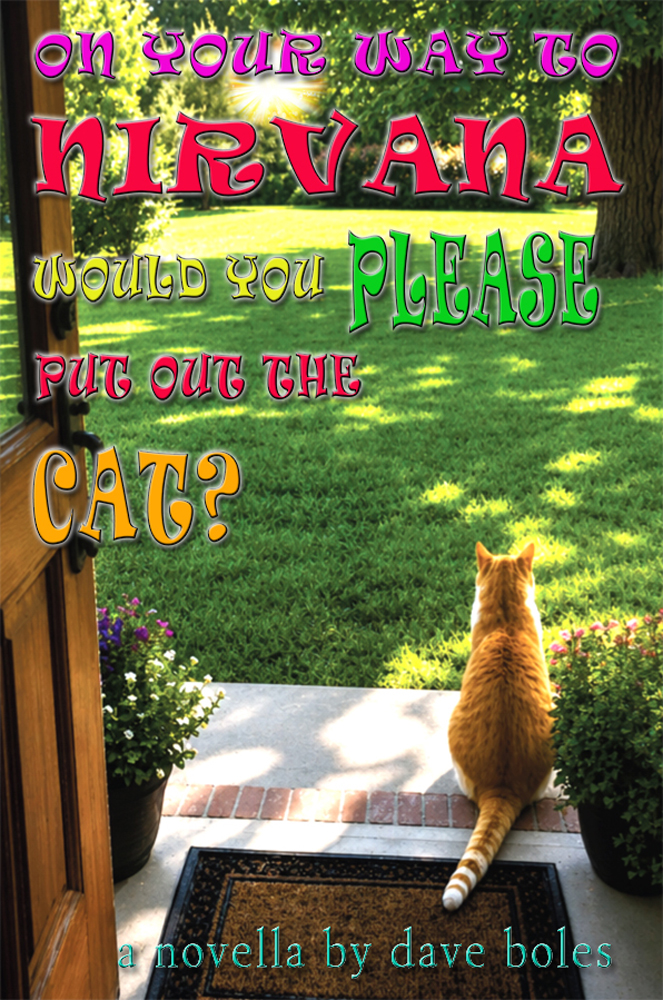
ON YOUR WAY TO NIRVANA Would You Please Put Out The Cat?
Large-Type Phone Edition • Free to Read
Dark humor, satire, about love and marriage and accountability. At the end I put an article I researched in the late 80s on LSD to treat alcoholism. That research is real and was the basis for the book. — dave boles
On Your Way To Nirvana explores the collision between ancient wisdom traditions and contemporary consumer culture, following seekers who chase enlightenment while stumbling over the mundane realities of everyday existence. Inspired by the pioneering medical and psychological research into psychedelic-assisted treatment for alcoholism dating back to the 1950s, the novel weaves together a darkly comic narrative with a substantive essay and historical exploration of LSD's role in early therapeutic applications. Through sharp wit and unflinching observation, Boles examines how the search for transcendence often trips over life's most ordinary obstacles—from household chores to digital distractions to our own contradictions. "We live in an age where everyone wants nirvana delivered by Amazon Prime," Boles notes. "This book asks what happens when our spiritual aspirations meet the messy, ridiculous reality of being human. Sometimes the most profound truth is that we forgot to feed the cat." The included historical essay provides intellectual depth to the satire, tracing how early researchers understood the therapeutic potential of psychedelics before decades of prohibition interrupted that scientific conversation.
Review: "On Your Way to Nirvana Would You Please Put Out the Cat?" Dave Boles has crafted a darkly comic and philosophically ambitious novel that operates on multiple registers simultaneously. On its surface, it's a sprawling narrative following a cast of morally compromised characters—a perpetually drunk insurance salesman, a wealthy corporate duo engaged in insider trading, a duplicitous securities investigator—whose lives collide in unexpected ways. But beneath that plot machinery lies something richer: a meditation on choice, consequence, and the possibility of genuine transformation. The novel's greatest strength is its narrative voice—omniscient, digressive, frequently hilarious, and deeply humane. Boles uses that voice to interrupt the action with philosophical asides (a brilliant disquisition on freedom-as-ice-cream), cultural commentary, and observations that feel earned rather than imposed. This narrative intrusion could feel precious in less capable hands, but Boles makes it work by grounding his philosophy in the messy lives of his characters. The ensemble cast is remarkably well-balanced. Humphries Feelgood, the drunk protagonist, could be a mere figure of ridicule, but the novel sympathetically traces how trauma, institutional failure, and systemic neglect can hollow out a person. Pierce Williams—the investigator forced to choose between integrity and love—provides the moral center. Lawrence and Amelia Mathews embody the theme that inherited wealth and privilege can corrupt even intelligent people into believing their own rationalization. If the novel has a weakness, it's its length and occasional structural repetition. Some moments repeat with minor variations, and the book occasionally meanders. But these aren't fatal flaws—they feel organic to a story fundamentally about people trying and failing and trying again to get it right. What lingers is the epilogue's central insight: redemption isn't arrival at some perfected state. It's a direction. A choice to walk a certain path, one decision at a time. In this age of redemption narratives and moral certainty, that humility feels revolutionary. Boles has written something genuinely humane—funny, angry, tender, and deeply serious about what it means to be human. - Larry V.
Review: "On Your Way to Nirvana Would You Please Put Out the Cat?" Dave Boles has crafted a darkly comic and philosophically ambitious novel that operates on multiple registers simultaneously. On its surface, it's a sprawling narrative following a cast of morally compromised characters—a perpetually drunk insurance salesman, a wealthy corporate duo engaged in insider trading, a duplicitous securities investigator—whose lives collide in unexpected ways. But beneath that plot machinery lies something richer: a meditation on choice, consequence, and the possibility of genuine transformation. The novel's greatest strength is its narrative voice—omniscient, digressive, frequently hilarious, and deeply humane. Boles uses that voice to interrupt the action with philosophical asides (a brilliant disquisition on freedom-as-ice-cream), cultural commentary, and observations that feel earned rather than imposed. This narrative intrusion could feel precious in less capable hands, but Boles makes it work by grounding his philosophy in the messy lives of his characters. The ensemble cast is remarkably well-balanced. Humphries Feelgood, the drunk protagonist, could be a mere figure of ridicule, but the novel sympathetically traces how trauma, institutional failure, and systemic neglect can hollow out a person. Pierce Williams—the investigator forced to choose between integrity and love—provides the moral center. Lawrence and Amelia Mathews embody the theme that inherited wealth and privilege can corrupt even intelligent people into believing their own rationalization. If the novel has a weakness, it's its length and occasional structural repetition. Some moments repeat with minor variations, and the book occasionally meanders. But these aren't fatal flaws—they feel organic to a story fundamentally about people trying and failing and trying again to get it right. What lingers is the epilogue's central insight: redemption isn't arrival at some perfected state. It's a direction. A choice to walk a certain path, one decision at a time. In this age of redemption narratives and moral certainty, that humility feels revolutionary. Boles has written something genuinely humane—funny, angry, tender, and deeply serious about what it means to be human. - Larry V.
© dave boles • Grass Valley, CA • boles.org