← to bookshelf
BOLES.ORG
dave boles
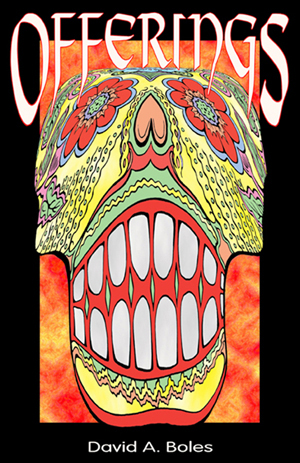
OFFERINGS with Forward by Charles Plymell
Large-Type Phone Edition • Free to Read
The title OFFERINGS seems to offer an innocent reality to it all. Be prepared to jump in deeper to what is offered so that you can relieveyourself next time by realizing you were not the one chosen to go there.
- Charles Plymell
Excerpt from the Forward written by Charles Plymell: When one learns that there is nothing fair in a society built on words that build those walls, the freedom is the road - the road upon which brings us the drama of David's poetry. The kind of apportioned deja vu that stands behind all real poets and makes their heart feel, their hair stand on end; those things which cannot be learned. The greatest halls of the academe may be successful in attempting to re-create these feelings. They may even be successful in teaching an appreciation, but the mimetic society hopelessly tries to make fiction, while poets who are wired as such cannot avoid the terror of the gray walls, the blown apart humans with forgotten names that society brings on, then avoids at all costs, all the while pissing in their stool.
REVIEW: The Road as Confession: On David A. Boles's Offerings
There is a moment early in David A. Boles's Offerings when a stranger appears out of a moonless dark to move a broken-down motorcycle just far enough down the highway to save its rider's life. The drunk driver who would have killed him instead kills himself in the empty space where the bike had been. It is a small, eerie parable, and it sets the terms for everything that follows: this is a book about the thin, arbitrary membrane between survival and annihilation, and about a narrator who has spent a lifetime riding along that membrane on two wheels, daring it to give way. That parable arrives after an introduction that announces its own quietly disorienting logic before a single poem begins. Charles Plymell's opening piece is titled, pointedly, "FORWARD"—not "Foreword," the spelling convention would supply, but "Forward," a choice too deliberate to read as a typo. The substitution feels like a thesis rather than an error: this is a book meant to move, not merely to be prefaced. Plymell's brief meditation on how each brain perceives reality differently, on memory as a site of continual negotiation rather than fixed record, and on the poet's peculiar obligation to notice the extraordinary lodged inside the ordinary, functions less as scholarly throat-clearing than as an invitation into Boles's own imaginative frame. By the time Plymell writes of poets navigating the terror of society's gray walls while others remain blind to it, the reader has already been primed for a collection that treats perception as unstable, freedom as a philosophical stance rather than a slogan, and the mundane—a stalled motorcycle, a bag of frozen potato rounds, a woman's satin pants split open before a mirror—as vessels for something larger. The misspelling, in other words, is the book's first offering: a small linguistic swerve announcing, before the poems even start, that nothing here should be taken at face value. Offerings refuses to settle into a single form, and that refusal is its most interesting formal decision. Boles moves from confessional narrative poem to prose vignette to satirical catalogue to elegy to something like blues lyric, often within the space of a few pages. "The Dance Continues" reads as origin myth—the poet's own hand made suddenly alive by an older mentor's example, words that had lain "limp and flaccid" on the page abruptly taught to move. "Blacktop Independent" widens the lens into a longer reckoning with biker culture itself, tracing the narrator's addiction to speed and violence to a breaking point where a knife fight, rather than ending in retaliation, ends in release—the realization that freedom and vengeance are not the same appetite. "Rights" pivots hard into satire, itemizing the hollow entitlements of citizenship—taxation, propaganda, predetermined verdicts—with a flat, sardonic cadence that recalls agitprop more than lyric. The book's willingness to lurch between registers, from tenderness to fury to dark comedy, mirrors the temperament of its narrator: a man who has apparently never trusted stillness. Mortality is the collection's steadiest undertow. "Remembrance" is its most wrenching piece, an account of the narrator's first dead body—a soldier torn apart by a mine, still lucid enough to ask to be remembered—and the narrator's confession, decades later, that he cannot recall the young man's name, having deliberately traded it away, "with the devil himself," for the ability to keep living. It is a genuinely harrowing piece of writing, and it clarifies what the book means by memory throughout: not a warm archive but a battlefield of things kept and things sacrificed to survive the keeping. Death recurs everywhere else too, in a gambler uncle who predicts his own heart attack mid-race, in the sheriff's roadside revelation of an earlier fatality, in the collection's closing elegy for "Wordslinger," a fellow poet whose lung disease finally silences a man who apparently never stopped talking, hunting, drinking, or writing until it did. Against all this violence and vanishing, Boles keeps returning to two counterweights: eros and creative compulsion. The love poems—for a "Dragonfly" woman burdened by unnamed demons, for a "Jodee Girl" fused to the narrator through motorcycle and moonlight—treat intimacy as another form of motion, another way of outrunning stillness rather than settling into it. "The Arrogance of Creativity" makes the metaphor explicit: the poet describes creative fire as something that cannot be switched on or off, only fed, a bargain struck once and paid forever after. Set against this earnestness, "The Room," a chilly indictment of anonymous online chat-room desire, functions as a kind of dark mirror—passion without contact, appetite without nourishment—and makes the book's real values, presence and risk, more legible by negative example. None of this arrives cleanly. Boles's diction is often raw to the point of bruising—colloquial, blunt, occasionally graphic (the vigilante killing in "Redemption" is not for the squeamish), and grammatically loose in ways that read less like oversight than like temperament: a voice unwilling to be tidied for the page. Readers looking for the polish of a workshopped lyric will find instead something closer to a testimony shouted from the back of a bike at ninety miles an hour, images arriving faster than syntax can properly hold them. The tonal whiplash between satire, elegy, and eroticism can feel less like intentional counterpoint and more like restlessness, and a few pieces—the domestic vignettes, the coffeehouse philosophizing—sit oddly among the book's harder-edged material, diluting momentum rather than deepening it. And yet the raggedness is, more often than not, the point, not the flaw. Offerings reads like a man setting down everything he was afraid he'd forget before the memory-trade caught up with him too—the dead soldier, the dead friend, the near-misses on dark highways, the women he could not save and did not stop loving anyway. It is not a comfortable book, nor a consistently graceful one. But it is an honest one, insistent in its belief that the road, the poem, and the body are all, in the end, the same offering: something laid down, at cost, so that someone else might pass.
© dave boles • Grass Valley, CA • boles.org