← to bookshelf
BOLES.ORG
dave boles
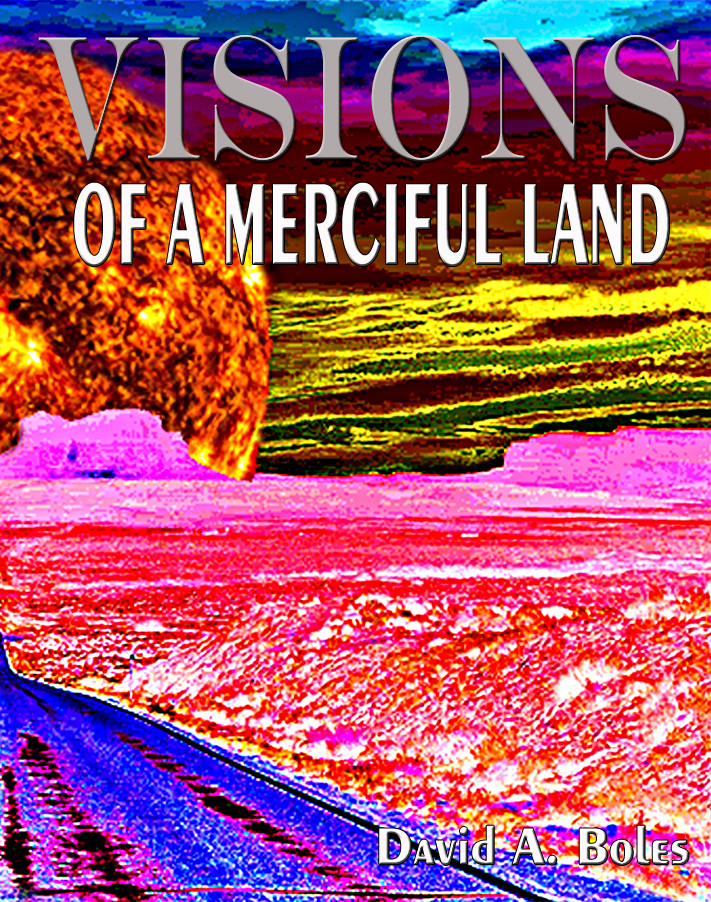
VISIONS Of A Merciful Land
Large-Type Phone Edition • Free to Read
Poetry for the seeking. Theosophical, spiritual, merciful — visions from the high desert and the lake house.
VISIONS OF A MERCIFUL LAND is a collection from my early work. It's spiritual poetry, but not preaching. Theosophical in the old sense — wisdom traditions, perception, the mental universe, doors of perception that remain ajar once opened. Love as a practice not a feeling. Like 4th Floor and Coyote Spirit, this one is fully interactive now — chapters linked, page headers back to TOC, footnotes linked both ways. Free to give away so the knowledge can go forward.
Visions Of A Merciful Land is a visionary journey through the wreckage and wonder of being alive, written by David A. Boles—the Gringo Shaman—a black ink junkie and relentless archaeologist of myth and history. Across these pages, ancient gods walk beside modern ghosts: Marduk demands his sacrifice, Garuda ascends toward immortality, Buddha pours coffee on a Tuesday morning, and Coyote whispers riddles into the ash of burning cities. Taoist stillness, Hindu cosmology, Sumerian memory, and Buddhist compassion collide with the noise of war, the silence of the starving, and the hollow promises of charismatic men who mistake power for grace. Boles does not flinch from what is broken.
Yet this is not a book that stays in the dark. It moves—stubbornly, tenderly—toward light. Through tattoos and letters to the dead, through homeless prophets and murmurations of starlings, through humor as sharp as it is holy, the poems trace a path from collapse toward tenderness, from erasure toward remembering, from fear toward freedom. What emerges is not doctrine but invitation: a merciful land glimpsed not in some distant heaven, but in the choice to soften what has been sharpened, and to love while there is still time.
A Review of Visions Of A Merciful Land
David A. Boles writes as though he has swallowed several civilizations whole and is still digesting their bones. Visions Of A Merciful Land is not a collection that asks to be read so much as one that demands to be survived—a sprawling, incantatory descent through myth, atrocity, tenderness, and dark comedy that refuses the comfort of a single register or a tidy thesis. This is visionary poetry in the oldest sense: the poet as seer, stumbling between worlds, reporting back what he has glimpsed on the other side of history's wreckage. The book's great achievement is synthesis without homogenization. Marduk demands his sacrifice in the same breath that Buddha pours coffee on an ordinary Tuesday. Garuda tears free of Naga bondage to earn his immortality while, elsewhere, a mermaid princess defies her father out of love. Taoist internal alchemy, the Shulba Sutras, shamanic peyote visions, Gnostic meditations, and the burial jars of the Fertile Crescent all share the same page, the same breath, the same hunger for meaning. Boles does not flatten these traditions into a vague spiritual mush; he lets them collide, argue, and occasionally illuminate one another, as though the world's sacred systems were fragments of a single shattered mirror he is patiently, stubbornly trying to reassemble. What keeps this mythic material from floating off into abstraction is Boles's insistence on the body and the earth. Bones rattle through these poems like a percussive undertone—giants' bones, buried infants, the unburied dead of wars that end without anyone having time to dig graves. Rivers appear again and again, as boundary, as memory, as the thing that will be paved into malls if we are not careful. Tattoos become a private liturgy: ink as confession, pain as a language the poet can control when grief itself proves unspeakable. Animals—coyotes, starlings, dolphins, dogs weighted and sunk—carry more moral clarity than most of the humans in these pages, and the recurring imagery of stars and light offers the collection's few unclouded promises of transcendence. The social and political critique here is unsparing. Boles writes with real fury about charismatic men who mistake power for grace, about bureaucracies that starve children while protecting "the system," about walls built for safety that become prisons for the people inside them. Gaza, Iraq, and unnamed battlefields recur not as abstractions but as accusations. There is a poem for the burning of the innocents in "ancient times" that sits, deliberately, beside a poem titled simply "Gaza, 2014"—the juxtaposition doing the work of argument without needing to say it aloud. This is poetry unafraid of being political, unafraid of naming complicity, including its own. Yet for all its grimness, the book is often very funny, in a way that catches you off guard. Buddha and Krishna open shirt shops on Venice Beach. An alien trades the keys to the universe for spare change and a round of drinks. This gallows humor is essential rather than decorative—it is the pressure valve that keeps the collection's darker material from curdling into despair, and it signals a poet who trusts his reader enough to laugh with him in the rubble. It would be dishonest to pretend the collection is uniformly polished. The poems are intentionally raw—nonlinear in their sequencing, sometimes abrupt in their transitions, occasionally rough at the level of the line. Readers looking for the tight architecture of a formal sequence will not find it here. But this roughness feels earned rather than careless; it mimics the disorientation of the visions themselves, the way revelation rarely arrives in complete sentences. The book's urgency—its sense of a man racing to get down what he has seen before it dissolves—depends on this unfinished quality. Sanding it smooth would cost it its authenticity. What ultimately distinguishes Visions Of A Merciful Land is its trajectory. It begins in sacrifice, erasure, and the burning of innocents, and it does not rush past that darkness—but it moves, poem by poem, toward something gentler: letters to the dead answered in blood and ink, a homeless man trading a seashell for stolen magic, a child asking if a new world is heaven. The merciful land the title promises is never handed to the reader as doctrine. It is earned, glimpsed sideways, built from compassion, memory, and the stubborn choice to soften what history has sharpened. For readers of visionary and spiritual poetry, for those drawn to socially engaged and formally unruly verse, and for anyone willing to sit with both the wreckage and the wonder of being alive, this collection rewards the journey. Boles has written something genuinely strange and genuinely necessary—a book that argues, through sheer accumulated vision, that mercy is still possible, even now, even here.
© dave boles • Grass Valley, CA • boles.org